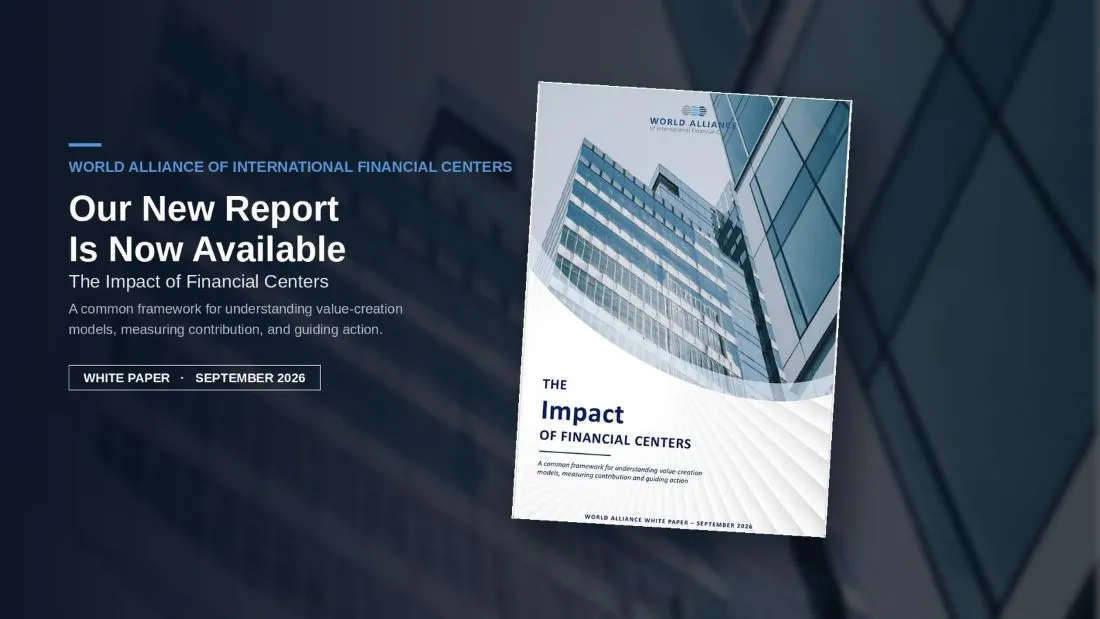
The World Alliance of International Financial Centers (WAIFC) has launched a new report examining the economic, institutional and international contributions of financial centers and introducing a common framework to better understand and measure their impact.
The report was developed with the support of SouthBridge and Afi, combining strategic and institutional expertise with applied economics and quantitative analysis. World Alliance members contributed data, insights and feedback throughout the project, with Casablanca Finance City coordinating the project.
Financial centers are increasingly recognized as important engines of economic development, connecting capital, businesses, talent and expertise across markets. Yet their contribution extends well beyond their direct financial activity, encompassing employment and value creation, capital flows, innovation, talent, institutional development and the international attractiveness of their host economies.
The scale of this contribution is reflected in the evidence collected for the report. Across the members for which data are available, financial-center activity supports more than 4.2 million jobs and generates more than USD 750 billion in value added. Among members reporting comparable data, financial-center activity represents, on average, 10–15% of tertiary-sector GDP and 7–12% of national fiscal receipts. Financial centers also operate as international gateways, connecting economies and markets across borders. Companies, investors and institutions represented across World Alliance member ecosystems originate from at least 130 countries, highlighting the breadth of international activity and relationships supported by financial centers.
Entitled "The Impact of Financial Centers: A common framework for understanding value-creation models, measuring contribution and guiding action," the report provides a structured approach for assessing this contribution across different types of financial centers. The framework comprises 59 key indicators across 24 thematic areas, covering the different channels through which financial centers generate economic and wider value.
Rather than ranking centers against one another, the framework recognizes that financial centers have different mandates, structures, markets and stages of development. It identifies four broad archetypes: Host Economy Catalysts, International Financial Gateways, Domestic Specialized Hubs and International Specialized Hubs, while recognizing that individual centers may combine characteristics of different models and evolve over time.
The analysis comes at a time when financial centers are operating in an increasingly competitive and rapidly changing environment. Technological disruption and artificial intelligence, competition for capital and talent, geopolitical fragmentation, and changing regulatory and policy requirements are all reshaping the conditions in which centers operate and develop.
The framework provides a practical basis for financial centers to assess their contribution, identify areas for further development, and track progress over time. It can also support more informed dialogue between financial centers, policymakers, regulators, investors and other stakeholders.
The publication marks a further step in the World Alliance's role as a platform for collaboration between established and emerging financial centers, enabling members to share experience, develop common perspectives and strengthen the contribution of financial centers to the global financial system.
Lamia Merzouki, Chair of the World Alliance of International Financial Centers, said:
"Years from now, the publication of this report will be remembered as a watershed moment for our industry. Financial centers are too diverse for a one-size-fits-all score or ranking to capture their impact. This work represents a true milestone for the World Alliance, establishing an unprecedented common framework to understand, measure, and amplify our contribution. Today, we are empowering our members to move from assertions to evidence-based outcomes and building a stronger narrative."
Dr Jochen Biedermann, Managing Director, said:
"The strength of this report comes from the collective effort behind it. Financial centers create value in different ways, and understanding that diversity is essential to capture their contribution properly. By bringing our members together around a common framework, the World Alliance can help translate the experience and outcomes of financial centers into shared knowledge and support stronger dialogue with stakeholders."
Hassan Belkhayat, Co-founder and Senior Partner, SouthBridge, said:
"Developing a common framework for assessing financial-center impact is particularly valuable at a time when financial centers are evolving rapidly and competing across increasingly interconnected markets. The framework provides a structured way to look at the different dimensions of value creation, from economic activity and international connectivity to innovation, talent and institutional development, while allowing each center to reflect its own specific characteristics."
Javier Paredes, Partner, Afi, said:
"Measuring the impact of financial centers requires looking beyond their direct economic footprint to understand the wider effects they generate across the economy. The framework developed through this work brings together a broad set of indicators to capture these different channels of impact and provides a robust basis for financial centers to track their contribution over time and identify areas for further development."