

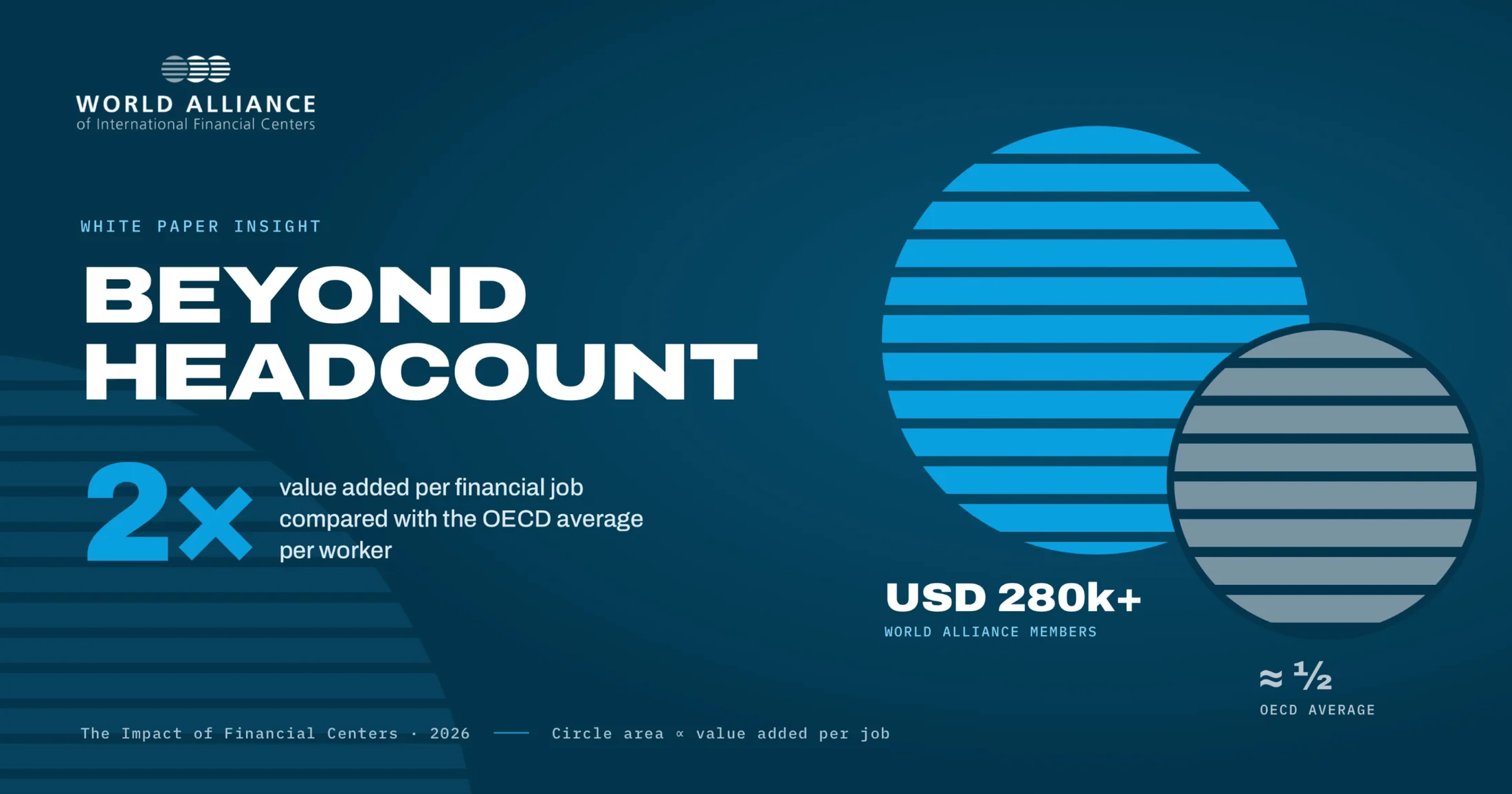
When financial centers make the case for their economic contribution, the conversation often starts with jobs. The World Alliance white paper The Impact of Financial Centers, released in Busan in September 2026, confirms that the numbers are significant: member centers with available data support more than 4.2 million jobs. Yet one of the report’s most telling findings concerns not how many people financial centers employ, but how much value each of those jobs creates.
Across reporting members, value added per financial job exceeds USD 280,000, nearly double the OECD average per worker. In some centers the gap is wider still: in The Bahamas, value added per financial job reaches around USD 540,000.
This productivity premium helps explain why financial centers carry a weight in their economies well beyond their share of employment. Among members reporting comparable data, financial centers typically represent 10 to 15 percent of tertiary-sector GDP and 7 to 12 percent of national fiscal receipts. In Jersey, the financial sector accounted for roughly two-thirds of fiscal receipts in 2025.
Employment is not standing still either. Jobs in financial centers are growing by about 2.4 percent per year, roughly twice the rate of their host economies. The effect also reaches beyond the center’s own perimeter: Frankfurt, for example, estimates that each direct financial job supports around five indirect jobs, a single documented case, the report notes, rather than an Alliance-wide ratio.
For policymakers, the finding carries a practical message. Focusing on headcount alone risks understating what a financial center contributes and, in some cases, misreading its strategy. This is particularly true for specialized hubs. The white paper’s framework distinguishes four archetypes of financial centers, and for Domestic Specialized Hubs and International Specialized Hubs it points to value added per employee and depth of specialization as more meaningful signals than the number of jobs.
Productivity is also closely tied to the factors that will shape the next phase of competition. The report finds that talent now ranks above cost among location factors, and that skills shortages are among the main barriers to scaling new technology. With Citi estimating in 2024 that 40 percent of banking tasks have high automation potential, the value of each financial job will increasingly depend on expertise that cannot easily be automated or relocated. At the same time, the 15 percent OECD global minimum tax is narrowing tax-based differentiation and shifting competition toward real substance: the people, skills and functions a center actually hosts.
Read together, these findings suggest that the question for financial centers is no longer simply how many jobs they create, but which functions they perform and how much value those functions generate on site. The white paper’s 59 key indicators, organized across 24 thematic areas, are designed to help centers measure exactly that, and to compare themselves with peers that share a similar value-creation model rather than against a single ranking.
The full white paper, The Impact of Financial Centers: A common framework for understanding value-creation models, measuring contribution and guiding action, was developed with the support of SouthBridge and Afi, with data and feedback from World Alliance members and coordination by Casablanca Finance City. It is available for download on the World Alliance website.