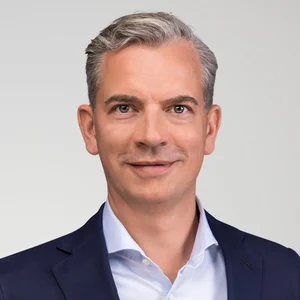

“For Europe, the time to act is now. First, build the most innovative digital infrastructure, beyond national silos. Second, direct private investment into the European capital market to truly scale it. Third, reshape the entire financial system toward the allocation of assets to innovation and growth.”
Europe stands at a crossroads. Yet we risk squandering this advantage through complacency and fragmentation. The time to act is now.
For too long, Europe has neglected the importance of a strong capital market. We have watched as innovation, breakthrough growth, and entrepreneurial ambition migrate across the Atlantic and to Asia. The reason is not a lack of capability – it is a too small capital market and a lack of truly European digital infrastructure to support it.
Consider the facts. The US capital market is roughly three times larger than Europe’s, despite comparable economic size. Why? Because there is a lot of private participation in the US capital market. Many US citizens are investors through private pensions, 401(k)s, and various other investment schemes. That is an area where Europe is lagging behind. Too few Europeans are invested in the capital market, which reduces its size relative to the United States. We need to increase the participation of European private investors to provide the capital to finance growth, innovation, and make our economy bigger and stronger.
But the participation challenge is only part of the story. The European capital market is not really a single capital market; it is a collection of many European national capital markets. This fragmentation is cumbersome and costly. Post-trade settlement costs are generally much higher in Europe than in the United States. We bleed competitiveness through inefficiency.
The capital markets union is no longer theoretical – it is essential. And this must also include upgrading Europe’s capital market infrastructure. Our infrastructure is fragmented into national silos, which is, of course, cumbersome and costly. Only through coordinated action can we improve this. Blockchain technology is a game changer here: It opens up the opportunity for us to overcome the existing national infrastructure silos that have developed over decades – through the establishment of digital, truly pan-European platforms.
Capital flows where there are attractive returns and business-friendly environments. Some 40 European unicorns have relocated to the United States because of more favorable regulatory conditions and a stronger capital market. When companies want to launch an IPO, they go where there is a strong capital market, and the US capital market is currently stronger than the various European ones. If we want to retain European innovation and attract capital inflows, we must create the conditions that make Europe the natural choice.
This extends to emerging areas like digital assets and tokenized finance. Crypto is here to stay. Digital capital markets – with issuance and settlement on the blockchain, settlement against digital money through stablecoins and central bank digital currencies – represent the critical market infrastructure of the future. Yet 99 percent of all stablecoins globally are denominated in US dollars. While there has been talk about global de-dollarization, when it comes to digital and stablecoins, it is dollarization. Europe must act if it does not want to be on the receiving end of this development.
The big bets we should all be making are clear: First, build the most innovative digital infrastructure, and do it as Europeans beyond national silos. Second, direct private investment into the European capital market to truly scale it. Third, reshape our entire financial system toward the allocation of assets to innovation and growth.
Europe has what it takes. We have a culture of innovation evident in our excellent universities and start-ups. What we need is the collective will to unleash it – through integrated infrastructure, regulatory clarity, and a commitment to competing, not retreating.
The next era of global finance will belong to those who evolve. Europe must choose to lead.
The articles published here reflect the views of the respective authors and not necessarily those of the WAIFC.